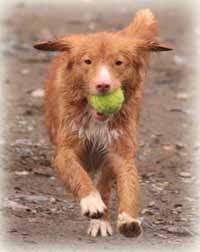
The Nova Scotia Duck Tolling Retriever was developed in
Nova Scotia in the early 19th Century to toll (or lure) and retrieve waterfowl. The tolling dog runs, jumps, and plays along
the shoreline in full view of a flock of ducks, occasionally disappearing from sight and then quickly reappearing, aided by
the hunter, who throws small sticks or a ball for the dog. The dog's playful actions arouse the curiosity of the ducks swimming
offshore and they are lured within gunshot range. The Toller is subsequently sent out to retrieve the dead or wounded birds.
The Toller is a medium-sized, powerful, compact, balanced, well-muscled
dog. They should show a high degree of agility, alertness, and determination. Many Tollers have a slightly sad expression
until they go to work, then their appearance changes to intense concentration and excitement. At work, the dog has a speedy,
rushing action, with the head carried out almost level with the back and heavily-feathered tail in constant motion.
Correct temperament of an adult Toller is gentleness, intelligence
and outgoing in the field. With strangers, adult Tollers generally are somewhat standoffish at first, especially if the owner
is distant. There should be no sign of aggressiveness in a general situation with people or with other animals.
The Toller was bred to retrieve from icy waters and must have a water-repellant
double coat of medium length and softness with softer dense undercoat. Due to the density of the coat tollers do "shed". A
Tollers topcoat will seasonally shed with a "coat-blow" of their undercoat once to twice a year.
People who are looking for a small version of a Golden or Lab in ob/field
or hunting work will find a major difference in the personalities of the breeds. On Average Tollers tend to be higher energy
then the average Golden/Lab, have less of the "love me" cuddle in your lap attitude, have a more independent nature and are
leary of strangers.
Puppy selection from a litter is usually up to the breeder. Most breeders
listen and learn from the owner what they want and expect from their Toller puppy; study their pups and during the seven to
eight weeks of early life select the individual puppy for each home. Many breeders do "temperment evaluations" at 7 weeks
of age to better evaluate the puppies for their homes. Check with your breeder to see what "tests" they preform on puppies
to select which puppy goes to which homes.
Tollers are not plagued with many of the genetic problems present
in other popular retriever breeds. Presently, breeders are working to keep problems to a minimum. Tollers who are
part of the breeding pool should be certified by the Orthopedic Foundation for Animals (OFA) to be free of hip dysplasia,
have current CERF examinations (This should be done every 12-18 months before they are bred and a clean bill of health produced
and given to puppy buyers) and be tested for PRA. This does not guarantee that the puppies will be free of the problem, but
it does go a very long way in insuring that breeders are doing everything they can to keep it limited. Many breeders will
offer written guarantees with their puppies, check with your breeder before getting a puppy to see what health guarantees
they offer and what healtch clearances they have on the parents of the litter.
Control is needed with firmness not harshness. You must let your Toller
know you are the leader of the pack and worthy of its respect and loyalty. Harshness only meets stubbornness. Nova Scotia
Duck Tolling Retrievers are very intelligent and will work well with a happy, gentle hand most times.
Nova Scotia Duck Tolling Retrievers can live in all weather
conditions - humid atmosphere, the desert areas, heavy winter areas, and all over the world. Tollers live in cities and out
in the country. Tollers must have adaquate shade and housing in hot climates as some tollers are prone to heat stroke. Make
sure your toller has access to shad and water at all times when you are travelling or living in hot climates.
Many Toller owners who compete in obedience/field/agility/flyball/tracking
report that the dog is happiest when working. However, they also report the Toller has its own timetable for learning. They
are bright, intelligent, and easy to train if you are experienced. However, they are ardent observers of life and as young
dogs are easily distracted in the ring. While they learn quickly, they also bore quickly. Training sessions must be kept short,
fun and challenging.
Today the Toller is multi-faceted. You get the ideal dog...a retriever,
a hunter, a loyal watchdog, a show dog (obedience or conformation) and a wonderful loving pet all rolled into one!
prcd-PRA Gene
The genetic disorder, prcd-PRA
, causes cells in the retina at the back of the eye to degenerate and die, even though the cells seem to develop normally
early in life. The “rod” cells operate in low light levels and are the first to lose normal function. Night blindness
results. Then the “cone” cells gradually lose their normal function in full light situations. Most affected dogs
will eventually be blind. Typically, the clinical disease is recognized first in early adolescence or early adulthood. Since
age at onset of disease varies among breeds, you should read specific information for your dog. Diagnosis of retinal disease
can be difficult. Conditions that seem to be prcd-PRA might instead be another disease and might not be inherited.
OptiGen’s genetic test assists in making the diagnosis. It’s important to remember that not all retinal disease
is PRA and not all PRA is the prcd form of PRA. Annual eye exams by a veterinary ophthalmologist will build a history
of eye health that will help to diagnose disease.
Unfortunately, at this time there is no treatment or cure for PRA.
Genetic testing for PRA is available for NSDTR's threw www.optigen.com
CEA Gene
Collies share Collie Eye Anomaly (CEA) with several other breeds – it’s
not just a problem for collies. CEA is more technically known as Choroidal Hypoplasia (CH). It is a recessively inherited
eye disorder that causes abnormal development of the choroid - an important layer of tissue under the retina of the eye. This
disease is seen most frequently in U.S. collies, but also worldwide in Rough and Smooth Collies, Border Collies, Australian
Shepherds, Lancashire Heelers, Shetland Sheepdogs and Nova Scotia Duck Tolling Retrievers. Since the choroid layer does not
develop normally from the start, the primary abnormality can be diagnosed at a very young age. Regrettably, there is no treatment
or cure for CEA.
The symptoms and signs – the clinical phenotype – can vary greatly
among affected dogs within one breed, between parent and offspring and even within a litter. This creates a difficult situation
for the breeder. Learning about the genetic cause and the course of the disease will help you understand how to manage it
better and eventually avoid it altogether with genetic testing.
The primary problem is choroidal hypoplasia (CH). There is under-development
(hypoplasia) of the eye tissue layer called the choroid. The choroid appears pale and thin, almost transparent, and the blood
vessels of the choroid can easily be recognized in those “thin” areas. The ophthalmologist, looking at the back
of the eye (the fundus) with an ophthalmoscope, typically will see an area of choroidal thinning that appears like a “window”
to the underlying vessels and sclera.
MILD disease: Mild disease is very common in U.S. collies and is present in
the other breeds named above. It is easily recognizable on careful ophthalmologic examination as early as 5 to 8 weeks of
age. The lesion appears as an area lateral (temporal) to the optic disc with reduction or absence of pigment so that the underlying
vessels of the choroid are seen. The choroidal vessels may be reduced in number and of abnormal shape. The underlying white
sclera might also be visible. Once the retina changes to its adult color around 3 months of age, the normal pigment sometimes
masks the changes in the choroid (so-called “go normal” – read more below). In mildly affected dogs, choroidal
thinning is the only detectable abnormality and the dog retains normal vision throughout life. However, dogs with mild disease
can produce severely affected offspring.
SEVERE disease: In severely affected dogs, approximately 25% of dogs with
CEA/CH, there are related problems with the health of the eye that can result in serious vision loss in some cases. Colobomas
are seen at and near the optic nerve head as outpouchings or “pits” in the eye tissue layers. Colobomas can lead
to secondary complications such as partial or complete retinal detachments and/or growth of new but abnormal blood vessels
with hemorrhage – bleeding inside the eye. This happens in 5-10% of dogs with CEA/CH, generally by 2 years of age, and
can affect either one or both eyes. Complications of severe disease can lead to vision loss, although this disorder only rarely
threatens total blindness.
CEA/CH is not progressive in the usual sense. The essential features, choroidal
hypoplasia and coloboma, are congenital – the abnormalities develop as the eye develops. These features are also stationary
once ocular development is complete around 8-12 weeks of life. Retinal detachments and/or aberrant vessel formation can be
congenital or develop later, in general only in eyes with colobomas.
Based on research done jointly by scientists at Cornell University and at
The Fred Hutchinson Cancer Research Center, BOTH the mild and severe forms of CEA/CH disease now are proven to result from
the exact same gene and mutation in ALL of the affected breeds named above. This disease gene is located on canine chromosome
number 37 and the disease-causing mutation has been identified. The mutation acts like a RECESSIVE mutation. That means, both
parents of an affected dog must have at least one copy of the mutation and both parents must have passed a copy of the mutation
to the offspring. The affected dog is HOMOZYGOUS RECESSIVE – that is, both copies of the gene are mutant. ALL dogs that
are homozygous recessive affected will show at least the mild form of the disease. ALL affected dogs, regardless of the actual
severity of the lesions, are homozygous for the same mutant gene.
Hip Displasia
Hip Dysplasia is a terrible genetic disease because of the various degrees
of arthritis (also called degenerative joint disease, arthrosis, osteoarthrosis) it can eventually produce, leading to pain
and debilitation.
The very first step in the development of arthritis is articular cartilage
(the type of cartilage lining the joint) damage due to the inherited bad biomechanics of an abnormally developed hip joint.
Traumatic articular fracture through the joint surface is another way cartilage is damaged. With cartilage damage, lots of
degradative enzymes are released into the joint. These enzymes degrade and decrease the synthesis of important constituent
molecules that form hyaline cartilage called proteoglycans. This causes the cartilage to lose its thickness and elasticity,
which are important in absorbing mechanical loads placed across the joint during movement. Eventually, more debris and enzymes
spill into the joint fluid and destroy molecules called glycosaminoglycan and hyaluronate which are important precursors that
form the cartilage proteoglycans. The joint's lubrication and ability to block inflammatory cells are lost and the debris-tainted
joint fluid loses its ability to properly nourish the cartilage through impairment of nutrient-waste exchange across the joint
cartilage cells. The damage then spreads to the synovial membrane lining the joint capsule and more degradative enzymes and
inflammatory cells stream into the joint. Full thickness loss of cartilage allows the synovial fluid to contact nerve endings
in the subchondral bone, resulting in pain. In an attempt to stabilize the joint to decrease the pain, the animal's body produces
new bone at the edges of the joint surface, joint capsule, ligament and muscle attachments (bone spurs). The joint capsule
also eventually thickens and the joint's range of motion decreases.
No one can predict when or even if a dysplastic dog will start showing clinical
signs of lameness due to pain. There are multiple environmental factors such as caloric intake, level of exercise, and weather
that can affect the severity of clinical signs and phenotypic expression (radiographic changes). There is no rhyme or reason
to the severity of radiographic changes correlated with the clinical findings. There are a number of dysplastic dogs with
severe arthritis that run, jump, and play as if nothing is wrong and some dogs with barely any arthritic radiographic changes
that are severely lame.
Auto-immune Thyroiditis
Autoimmune thyroiditis is the most common cause of primary hypothyroidism
in dogs. The disease has variable onset, but tends to clinically manifest itself at 2 to 5 years of age. Dogs may be clinically
normal for years, only to become hypothyroid at a later date. The marker for autoimmune thyroiditis, thyroglobulin autoantibody
formation, usually occurs prior to the occurrence of clinical signs. Therefore, periodic retesting is recommended.
The majority of dogs that develop autoantibodies have them by 3
to 4 years of age. Development of autoantibodies to any time in the dog’s life is an indication that the dog, most likely,
has the genetic form of the disease. Using today's technology only a small fraction of false positive tests occur.
As a result of the variable onset of the presence of autoantibodies,
periodic testing will be necessary. Dogs that are negative at 1 year of age may become positive at 6 years of age. Dogs should
be tested every year or two in order to be certain they have not developed the condition. Since the majority of affected dogs
will have autoantibodies by 4 years of age, annual testing for the first 4 years is recommended. After that, testing every
other year should suffice. Unfortunately, a negative at any one time will not guarantee that the dog will not develop thyroiditis.
The registry data can be used by breeders in determining which
dogs are best for their breeding program. Knowing the status of the dog and the status of the dogs lineage, breeders and genetic
counselors can decide which matings are most appropriate for reducing the incidence of autoimmune thyroiditis in the offspring.
The Canadian Kennel Club Breed Standard
General Appearance
The
Toller is a medium-sized, powerful, compact, balanced, well-muscled dog; medium to heavy in bone, with a high degree of agility,
alertness, and determination. Many Tollers have a slightly sad expression until they go to work, when their aspect changes
to intense concentration and excitement. At work, the dog has a speeding, rushing action, with the head carried out almost
level with the back and heavily-feathered tail in constant motion.
Temperament
The
Toller is highly intelligent, easy to train, and has great endurance. A strong and able swimmer, he is a natural and tenacious
retriever on land and from water, setting himself for springy action the moment the slightest indication is given that retrieving
is required. His strong retrieving desire and playfulness are qualities essential to his tolling ability.
Loving and playful to his family, he can be reserved with strangers without
being aggressive or overly shy. Aggression is not to be tolerated.
Size
Ideal height
for males over 18 months is 19-20 inches (48-51 cm); females over 18 months 18-19 inches (45-48 cm). One inch (3 cm) over
or under ideal height is allowed. Weight should be in proportion to the height and bone of the dog guidelines: 45-51 lb. (20-23
kg) for adult males; bitches 37-43 lb. (17-20 kg).
Coat and Colour
The
Toller was bred to retrieve from icy waters and must have a water-repellent double coat of medium length and softness with
a softer, dense undercoat. The coat may have a slight wave on the back, but is otherwise straight. Some winter coats may form
a long, loose curl at the throat. Featherings are soft at the throat behind the ears and at the back of the thighs, and forelegs
are moderately feathered. While neatening of the ears and feet is permitted, the Toller should always appear natural. Colour
is various shades of red or orange with lighter featherings and underside of tail, and usually at least one of the following
white markings - tip of tail, feet (not exceeding beyond the pasterns), chest, and blaze. A dog of otherwise high quality
is not to be penalized for lack of white. The pigment of the nose, lips and eye rims should match, and be flesh coloured,
blending with coat, or be black.
Head
Skull: the
head, which should be in proportion to the body size, is clean-cut and slightly wedge-shaped when viewed from above. The broad
skull is only slightly rounded, the occiput not prominent and the cheeks flat. Length from occiput to stop should roughly
equal that of stop to tip of nose. The stop is moderate. Muzzle: tapers in a clean line from stop to nose, with the lower
jaw strong but not prominent.
The underline of the muzzle runs almost in a straight line from the corner
of the lip to the corner of the jawbone, with depth at the stop being greater than at the nose. Hair on the muzzle is short
and fine. Whiskers are not removed. Nose tapers from bridge to tip, with nostrils well open. Colour should blend with that
of the coat or be black. Mouth: lips fit fairly tightly, forming a gentle curve in profile, with no heaviness in flews. The
correct bite is tight scissors, full dentition is required. Overshot by more than 1/8 inch, under shot and wry mouth are highly
undesirable. Jaws are strong enough to carry a sizable bird, and softness in mouth is essential. Eyes set well apart, almond
shaped, medium-sized. Colour, amber to brown. Expression is friendly, alert and intelligent. Flesh around the eyes should
be the same colour as the lips.
Ears triangular, rounded at the tips, medium-sized and carried in a dropped
fashion. They are set high and well back on the skull, with the base held very slightly erect so that the edge of the ear
is carried to the side of the head. They are well feathered at and behind the fold, with short hair at the tips.
Neck
Slightly arched,
strongly muscled and well set-on, of medium length, with no indication of throatiness.
Forequarters
Shoulders
should be muscular, with the blade well laid back and well laid on giving good withers sloping into the short back. The blade
and upper arm are roughly equal in length with the upper arm well angled back under the body.
Elbows should be close to the body, turning neither in nor out, working cleanly
and evenly. The forelegs should appear as parallel columns, straight and strong in bone. The pasterns are strong and slightly
sloping. The strongly-webbed feet are tight and round, with well-arched toes, thick pads and strong nails, and are in proportion
to the size of the dog. Dewclaws may be removed.
Body
Deep-chested
with good spring of rib, brisket reaching to the elbow. The back is short and straight, the topline level, the loins strong
and muscular. The ribs are well-sprung, neither barrel shaped nor flat. Tuck-up is moderate.
Hindquarters
Muscular,
broad, and square in appearance. Rear and front angulation should be in balance. Thighs are very muscular, upper and lower
sections being approximately equal in length. Stifles are well bent and hocks well let down, turning neither in nor out.
Dewclaws must not be present.
Tail
Following
the natural very slight slope of the croup, broad at the base, luxuriant and heavily feathered, with the last vertebra reaching
at least to the hock. The tail may be carried below the level of the back except when the dog is alert when it curves high
over, though not touching the back.
Gait
The Toller
combines an impression of power with a springy, jaunty gait, showing good reach in front and a strong driving rear. Feet should
turn neither in nor out and the legs travel in a straight line. As speed increases, the dog should single-track, topline remaining
level, and covering ground with economy of movement.
Faults
(To be penalized according
to degree)
1. Dogs more than 1 inch (3 cm) over or under ideal height.
2. Overshot
bite.
3. Tail too short, kinked or curled over touching the back.
4. Lack of substance in adult dog.
5. Dish or down-faced.
6.
Abrupt stop.
7. Large, round eyes.
8. Nose, eye rims, and eyes not of prescribed colour.
9. Bright pink nose.
10.
Splayed or paper feet, down in pasterns.
11. Open coat.
12. Roached, sway back, slack loins.
13. Tail carried below
level of back when dog gaiting.
14. Any departure from the foregoing points should be considered a fault and penalized
according to the degree of deviation.
Disqualifications
1. White on shoulders, around ears, on back of neck, across back or flanks.
2.
Silvery coat, grey in coat, black areas in coat.
3. Lack of webbing.
4. Undershot bite, wry mouth.
5. In adult classes,
any shyness.
6. Butterfly nose.
7. Overshot by more than 1/8 inch.
8. Any colour other than red or orange shades.